People Experiencing Homelessness May Qualify for an Economic Impact Payment

People experiencing homelessness may be eligible for a $1,200 Economic Impact Payment and $500 for each qualifying child under age 17. To get this payment, they must register with the IRS by using the free Non-Filers: Enter Payment Info Here tool by Saturday, November 21, 2020.

If someone's income is below $12,200, or $24,400 if they're married, they probably don't file a tax return. That means the IRS may not have enough information to issue their payment.

The free Non-Filers: Enter Payment Info Here tool is available in English and Spanish.

People who don't normally file a tax return may be eligible for an EIP if they:

  • Are a U.S. citizen, permanent resident or qualifying resident alien

  • Have a work-eligible Social Security number

  • Cannot be claimed as a dependent of another taxpayer

To use the tool, a person needs:

  • Name, as it appears on Social Security card, for self and spouse, if they are eligible

  • A work-eligible SSN for self and spouse, if they are eligible

  • For each qualifying child, name, relationship and SSN or Adoption Tax Identification Number

  • An email address to help create an account to use the Non-Filers tool

  • A mailing address where they can receive the payment and a confirmation letter, which the IRS will mail within 15 days after issuing their payment

  • Banking information, including routing and account numbers, if they want their payment via direct deposit

  • An Identity Protection Personal Identification Number, if the IRS sent one in the past. If a person lost it, they can use the Get an IP PIN tool at IRS.gov to retrieve their number

The Non-Filers tool asks for a user's license or state ID number to digitally sign the document. There are other ways to do this, so an ID is optional in the tool.

If someone wants their payment by direct deposit but doesn't have a bank account, they can visit the FDIC website for help. The IRS will mail a payment to anyone who doesn't give direct deposit information.

Other key points about Economic Impact Payments

  • The IRS highly recommends the online Non-Filers tool for the fastest Economic Impact Payment.

  • People who can't access or use the tool should follow the steps in the Non-Filers tool section of the Economic Impact Payment FAQs. Someone who mails a simplified paper tax return to get their Economic Impact Payment, rather than using the Non-Filers tool, must submit it by Thursday, October 15, 2020.

  • If someone misses the November 21 deadline, they can claim the payment as a credit on a 2020 federal income tax return next year.

  • The payment is not taxable income and getting one does not affect eligibility for other benefits, such as the Supplemental Nutrition Assistance Program, unemployment benefits or other benefit programs.

  • People can use the Get My Payment tool at IRS.gov within two weeks to check their payment status.

More information:

https://www.irs.gov/newsroom/people-experiencing-homelessness-may-qualify-for-an-economic-impact-payment

Help for Westchester Homeowners with Mortgage Arrears

If you are a Westchester homeowner and resident who is facing foreclosure due to four months or less of mortgage arrears due to Covid-19, we can help. Westchester County has provided The Bridge Fund of Westchester with a grant to help those facing foreclosure to pay their arrears and save their homes.

The money we provide to eligible homeowners does not have to be repaid. But the funds we have will expire at the end of 2020, so act now to find out if you are eligible for this assistance.

  • You must be a single family homeowner whose primary residence is in Westchester County.

  • The cause of the arrears must be due to Covid-19.

  • You must not owe more than four months. Arrears owed prior to April 1, 2020 are ineligible.

  • The money will be paid directly to the bank where the mortgage is held.

  • You do not have to repay the money to The Bridge Fund of Westchester.

For more information, call The Bridge Fund of Westchester: (914) 949-8146

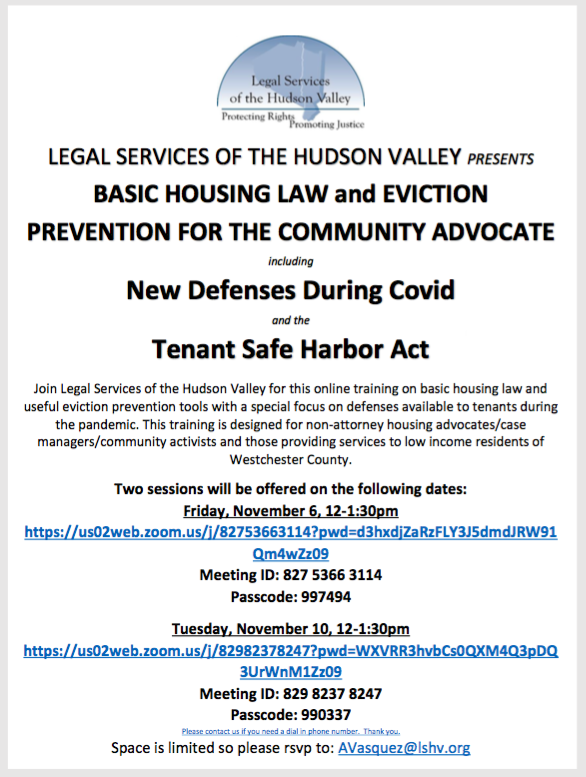
Housing Law & Eviction Prevention for Community Advocates Presentation

Screen Shot 2020-10-28 at 3.42.13 PM.png

Basic Housing Law & Eviction Prevention for the Community Advocate

Two sessions will be offered on the following dates:


Friday, November 6, 12-1:30pm

https://us02web.zoom.us/j/82753663114?pwd=d3hxdjZaRzFLY3J5dmdJRW91 Qm4wZz09
Meeting ID: 827 5366 3114
Passcode: 997494

Tuesday, November 10, 12-1:30pm

https://us02web.zoom.us/j/82982378247?pwd=WXVRR3hvbCs0QXM4Q3pDQ3UrWnM1Zz09

Meeting ID: 829 8237 8247

Passcode: 990337

Please contact AVasquez@lshv.org if you need a dial in phone number.
Space is limited so please rsvp to: AVasquez@lshv.org

Westchester IDA Approves Incentives For Affordable Housing

The Westchester County Industrial Development Agency (IDA) recently voted preliminary approval of $912,062 in financial incentives for the renovation of two affordable housing developments in Mount Vernon and Tarrytown. The two projects comprise a total of 250 units of affordable housing.

The IDA Board gave preliminary approval of $653,672 of financial incentives and $27.5 million in tax-exempt bond financing for renovating Ebony Gardens, a multi-family complex in Mount Vernon comprised of seven garden-style apartment buildings with a total of 144 units of affordable housing targeting tenants earning 60 percent of area median income.

Renovations will include upgraded kitchens and baths, new windows, new roofs, upgrading of facades and upgrading of mechanical systems. In addition, there will be a new amenities building with a fitness room, business center and community room. The complex will be wired for wifi that will be provided free of charges to the residents.

Renovations will include new kitchens and baths, new roofing and windows and improvement to mechanical systems for greater energy efficiency.

Located at 138 South Sixth Avenue, Ebony Gardens was built in the early 1980s and was in continuous operation as housing for low-income families. The $7.9 million renovation project is expected to create 41 construction jobs and create and retain 40 full-time jobs. The developer of the project is an affiliate of Related Companies, one of the largest developers and preservationists of affordable and workforce housing in the nation.

The Board has also voted preliminary approval of $258,392 in financial incentives for renovation of Asbury Terrace Apartments, a nine-story, 106-unit apartment building located at1 River Road in Tarrytown. The building features 36 one-bedroom apartments, 45 two-bedroom apartments, 25 three-bedroom apartments, plus an apartment for the building superintendent. The building is being acquired by Mountco Construction and Development Corp. of Scarsdale which has successfully renovated 17 former HUD properties like Asbury Terrace.

https://patch.com/new-york/tarrytown/westchester-ida-approves-incentives-affordable-housing

THE YOUTH SHELTER PROGRAM -WESTCHESTER PRESENTS-AN EVENING WITH BAKARI SELLERS

The Youth Shelter Program of Westchester is proud to announce An Evening with Bakari Sellers. Bakari T. Sellers is an American attorney, political commentator, former member of the South Carolina House of Representatives and author. Mr. Sellers is a CNN Contributor and has appeared on shows such as the HBO series, Real Time with Bill Maher. He is sought after for his passionate political and social commentary and analysis informed by first-hand experience.

The Youth Shelter Program of Westchester invites the public to attend this virtual fundraiser on Thursday, October 29 at 6:00 pm. 

Click here for full details.

Affordable Housing Complex Approved in New Rochelle- 77 Units for DV Survivors

The New Rochelle Industrial Development Agency recently approved plans to construct a 100 percent affordable residential tower in the downtown center of New Rochelle. The 20-story property will take shape at 11 Garden Street and is designed by architect Stephen B. Jacobs Group.

The property will yield 219 rental units ranging from studios to three-bedroom homes. Additional components include a parking garage for 172 vehicles, a private playground for residents, and a new public plaza at the corner of Garden Street and North Avenue. A total of 77 units will be reserved for victims of domestic violence.

Read the full article here

SUPPORT RIGHT TO COUNSEL FOR LOW INCOME TENANTS IN WESTCHESTER COUNTY

Even before the pandemic struck, over 10,000 Westchester households faced eviction each year and nearly 5,000 people annually entered Westchester's shelter system. 

Eviction cases in Westchester housing courts are lopsided: 93% of landlords have attorneys but only 7% of tenants do. Tenants without legal representation typically lose their cases - and their homes - in just 3-4 minutes in a blur of rapid-fire judicial action.

Now the rental housing market in Westchester is in crisis. The pandemic recession has interrupted or destroyed thousands of Westchester families' jobs. The August 2020 unemployment rate in Westchester is still 11.1%. Thousands of Westchester households have been unable to pay their rent. There are state and federal moratoria that postpone evictions, but the unpaid rents continue to accumulate. As a result, Westchester is facing a "tsunami of evictions" when the current moratoria on evictions are lifted.

A Westchester Right 2 Counsel Coalition has been created to create a right to counsel for low-income tenants facing eviction. Similar programs have already been established in cities across the country including NYC, Cleveland and Minneapolis. These programs have effectively reduced the number of people annually evicted.

The R2C Coalition is asking Westchester residents to contact their county legislators and urge them to pass Right 2 Counsel legislation in Westchester. We can't afford to wait and let hundreds or even thousands more Westchester households flood our already over-burdened homeless shelter system. Please call or email your county legislator today!

-Karl Bertrand, LMSW
Co-Chair, Westchester County Continuum of Care Partnership for the Homeless
President/C.E.O., Program Design and Development, LLC

Learn more

Legal Aide Society Secures Permission to Intervene on Litigation

To the dismay of landlords, tenants now have a seat at the table in the legal challenges to New York’s rent law.

In two of the five cases that challenge last year’s law — one brought by the Building and Realty Institute of Westchester, and the other brought by G-Max management — U.S. District Judge Kenneth Karas granted a motion to intervene from attorneys representing tenant groups Community Voices Heard and Tenants & Neighbors.

The latest decision means tenant attorneys will now be a party to each of the five separate legal challenges, giving them the power to file motions and make arguments on the tenants’ behalf.

Click Here to Read Full Details.

Attorney General Letitia James Announces Grantees for COVID-19 Tenant Legal Assistance Initiative

New York Attorney General Letitia James today announced the recipients of the COVID-19 Tenant Legal Assistance Initiative grants, a program that was launched earlier this year to support housing during COVID-19. The six grantees will develop and manage regional volunteer attorney programs across the state to provide support for tenants facing eviction due to the COVID-19 pandemic. In addition to providing legal support, as part of the program, these organizations will work together to identify systemic housing issues that New Yorkers outside of New York City face.

Click here to read the full press release.

The Community Build Back Program

Westchester County Executive George Latimer Announces The Community Build Back Program To Assist Westchester Residents Facing Homelessness Due To The Covid-19 Pandemic 

  (White Plains, NY) – In an effort to stabilize communities and families in the County impacted by the COVID-19 pandemic, Westchester County Executive George Latimer is announcing the Community Build Back Program.  The four pronged umbrella Program has four programs under it.  Two utilize HUD money, the RED STOP Eviction Project and the RED Rent HELP Project, and two separate ones utilize $10 million dollars in CARES ACT money the Blue Priority Homeowners Initiative and the Blue Small Business Landlord Initiative.

Latimer said: “As a result of COVID-19 and the impact on the economy, both the federal government and New York State issued moratoriums on tenant evictions.  Those moratoriums are coming to an end and unemployment benefits have been greatly diminished.  The Community Build Back Program will enable families to stay in their homes as we head into the fall/winter season.”  

The RED STOP Eviction Project utilizes federal HUD funds and will provide up to 4 months of rental or utility arrears for tenants facing eviction or shut off as long as they can demonstrate that their financial hardship is due to COVID.  Tenants must be within 21 days of eviction, must demonstrate ability to pay their rent going forward, and must live in a Westchester Urban County Consortium municipality.  Assistance is available through select non-profits including: Westchester Residential Opportunities, Community Housing Innovations, Washingtonville Housing Alliance and Choice of New Rochelle. 

RED Rent HELP Project – “moving forward” also utilizes federal HUD funds and will provide up to 12 months of rental assistance for families impacted by COVID but focus on households where the tenants worked in industries closed until Phase 4, or who worked for a business that no longer exists. RED Rent HELP Project will be run by the County’s Planning Department.

The Blue Priority Homeowners Initiative, uses $2.5 million dollars and focuses on homeowners facing foreclosure.  That part of the Program, which is estimated to help 325 households in the County, and assist them with up to 4 months of mortgage / cooperative arrears.  Homeowners must show that COVID has negatively impacted their ability to pay their mortgage.  The homeowner will also have to show that they were up to date on payments as of March 2020.  This part of the Program also runs until the end of the year and will be administered through select nonprofits including: Westchester Residential Opportunities, Community Housing Innovations, Washingtonville Housing Alliance, HDSW (Human Development Services of Westchester) and the Bridge Fund.

Westchester Residential Opportunities, Inc. Executive Director Marlene Zarfes said: “This eviction prevention program will be a lifesaver for so many County residents at risk of becoming homeless.  Westchester Residential Opportunities is proud to partner with the County to help keep people safely in their homes and keep families together.”

For the Blue Small Business Landlord Initiative, $7.5 million dollars has been earmarked to assist approximately 2,400 households in the County by working directly with their landlords and bringing their rent up to date. The Program runs from now until the end of 2020, and can cover up to 75% of back rent for up to 4 months of rent for landlords who can show that their tenants were up to date in March, but have since not been able to pay their rent due to COVID.  This program, to be done by lottery, will assist landlords who own between 4 and 20 units.  Blue Small Business Landlord Initiative will be run by the County’s Planning Department.

Building & Realty Institute (BRI) of Westchester and the Mid-Hudson Region Executive Director Tim Foley said: "We're thankful for the creative leadership shown by Westchester County's Community Build Back Program, and the focus on supplying urgently-needed aid to struggling tenants, landlords, and property owners alike. The landlords and property owners of the Building & Realty Institute have been checking in on our at-risk tenants, offering flexibility and payment plans on their rent, and trying to be as accommodating as possible to good tenants who lost their jobs or lost income due to the COVID pandemic. But as the public health and economic emergency stretches on with no end-date in sight, we need government to step up to stabilize our housing situation. With this four-prong approach, Westchester County is clearly doing so."

Latimer said: “Landlords, many times, are small business owners who depend on the rent from their properties to support their own families.  We realize the chaos that nonpayment can put into their lives and their communities.  The last thing we want to see is a landlord lose their property over nonpayment.  That benefits no one.”

Board of Directors of the Apartment Owners Advisory Council Member Carol Danziger said: "I am thankful to Westchester County for setting up these programs aimed at helping tenants and landlords during this crisis. I'm a second-generation owner of a family-run small apartment building, like so many small business owners, COVID-19 took any financial problems we had and made them that much worse. After the financial hardships and unimaginable personal losses we've experienced, we are still here for our tenants if the needs arise, especially if anyone is struggling. But since we do basically everything ourselves and have no staff, there was no relief for us under the CARES Act previously, and we were quickly running out of options and flexibility. These subsidies and stabilization funds will help us remain steady while the public health emergency continues this fall."

Fact Sheets and Applications (English and Spanish) for the programs are available on the County’s website at:  www.westchestergov.com/HousingHelp.


COVID-19 Homeless System Response: Strategies for Renter Protection

Rental households, especially those with extremely low income and disabilities, are particularly vulnerable to homelessness if they are evicted. When households are evicted, they not only lose their housing stability, but they may also forfeit security deposits and incur recorded debt and a negative rental history. This affects not only the individual responsible for violating lease conditions, but also other household members. Communities can balance rental requirements and responsible property management with efforts to prevent homelessness by partnering with tenants, landlords, and service providers. These partnerships can ensure vulnerable households are provided with the support they need to successfully maintain housing.

Nationally landlords either have been or are still under a wide variety of federal, state, and local moratoriums on evictions, late fees, and penalties related to nonpayment of rent. As those moratoriums are lifted or expire, communities should anticipate a rising demand for eviction prevention assistance as the COVID-19 outbreak continues and unemployment remains high. There is also a wide variety of federal, state, and local legal protections for renters regarding applications, deposits, habitability standards, security, privacy, evictions, and retaliation. While communities develop and implement strategies for eviction prevention, they should also invest in renter protections for Continuum of Care (CoC) and Emergency Solutions Grants (ESG) program participants, as well as the general public. This document addresses strategies to reduce evictions and exits from housing programs and includes a community profiles of Chicago’s Re-ntervention program.

To read the full document click here - Strategies for Renter Protection

Mount Vernon's Patterson-Howard joins Mayors for Guaranteed Income to help working poor

Mayor Patterson-Howard joined the newly formed Mayors for A Guaranteed Income (MGI), a growing coalition of twenty-five mayors from across the country, to advocate for unconditional direct cash payments and guaranteed income at the local, state, and federal level.

MGI launched on June 29, 2020 in an effort to address the growing economic disparities in communities across the nation. With 44% of American workers earning just about $18,000 a year, income and wealth inequality has reached historic highs. Many Americans work multiple jobs and still struggle to afford even the most basic of necessities, nearly 40% of all Americans cannot afford a $400 emergency. The emergence of COVID-19 has only exacerbated the deeply rooted issue of income inequality and has demonstrated the disproportionate impact it has had on minority communities. Now more than ever Americans across the nation need Guaranteed Income.

Mayor Patterson-Howard becomes the first mayor in the lower Hudson Valley region to join the coalition. As the coronavirus pandemic continues to plague residents and create economic instability, Mayor Patterson-Howard has pledged to invest in changing the narrative. As a strong advocate of cash-based policies, Mayor Patterson-Howard is pushing forward to create a pilot program that will supplement, rather than replace, existing financial support to residents. Earlier this year, Mayor Patterson-Howard announced the Financial Navigators program which will provide individuals with the tools to raise their financial capacity.

Mayor Patterson-Howard said, “Cash is the currency of urgency. In Mount Vernon, economic security is a quintessential building block for local families. With rising unemployment, food insecurity and a federal government that has failed to protect taxpayers, we have decided to act. As a long time, advocate for cash-based policies that improve the economic outcomes for residents I am excited to join my fellow mayors in this coalition. Guaranteed income for Mount Vernon residents will be a game changer and by generating innovative ideas to solve big problems, we can empower our community. In the next few months we will be unveiling our pilot program that will direct cash payments to families most in need.”

The pilot program for Mount Vernon is still in the early stages of implementation. The Patterson-Howard administration will be focusing on families who are on the cliff of financial distress, that includes those facing: homelessness, eviction, utility disconnection, unemployment, debt and other issues. Community input and involvement will be critical as the program is developing innovative and creative ways to implement a “New Deal” for Mount Vernon. By identifying public & private monies in addition to funds from the CARES act as starting capital, the goal of providing families with $500 cash payments directly over a 12–18-month period should be attainable.

https://medium.com/@MayorSPH/mayor-patterson-howard-joins-mayors-for-guaranteed-income-coalition-6692cfcf6199

GOVERNOR CUOMO ANNOUNCES THE AVAILABILITY OF UP TO $158 MILLION TO ADVANCE ACTION PLAN COMBATING HOMELESSNESS

Homeless Housing and Assistance Program to Provide $128 Million in Capital Funding for Permanent Supportive Housing Projects; Emergency Shelter Repairs


Up to $30 Million in Operating and Service Funding Also Available Through the Governor's Empire State Supportive Housing Initiative

Governor Andrew M. Cuomo today announced the release of two requests for proposals for programs that build and support homeless housing across the state. Combined, the Homeless Housing and Assistance Program and the Empire State Supportive Housing Initiative make available $158 million for projects that will house New Yorkers experiencing homelessness and provide supportive services aimed at addressing the root causes of housing instability. This funding continues the work of the Governor's unprecedented $20 billion, five-year housing plan, which is creating or preserving 100,000 units of affordable housing and has spurred the development of more than 6,600 of supportive housing units across the state.

"For many who experience homelessness, housing insecurity is only a symptom of an even greater underlying problem," Governor Cuomo said. "Projects that address both the shelter and support needs of those experiencing homelessness are at the vanguard of our efforts to ensure all New Yorkers have a safe, stable place to live. These programs represent a crucial investment in our communities and to ensuring the most vulnerable among us aren't left to languish on the streets."

New York State's Homeless Housing and Assistance Program (HHAP) is providing up to $128 million in capital funding for projects that propose to build supportive housing units or to repair emergency shelters -an amount that is double the prior year's allocation. In addition, the Empire State Supportive Housing Initiative (ESSHI) is accepting proposals for up to $30 million for the ongoing services and operation of supportive housing for individuals experiencing homelessness and with special needs, conditions, or other life challenges.

Building on his commitment to the five-year, $20 billion housing plan, Governor Cuomo's enacted 2021 state budget increased the available funding for the Homeless Housing and Assistance Program from $64 million to $128 million. This funding includes $5 million earmarked for supportive housing for homeless veterans; $5 million for supportive housing for individuals with AIDS who are experiencing homelessness; and $1 million for necessary repairs to emergency shelters.

The Homeless Housing Assistance Program provides capital grants and loans to not-for-profit corporations, charitable and religious organizations, and municipalities to acquire, construct, or rehabilitate housing for persons who are unable to secure adequate housing without special assistance. The grants are awarded through a competitive process by the New York State Homeless Housing and Assistance Corporation, a public benefit corporation staffed by the state Office of Temporary and Disability Assistance (OTDA).


Through this program, New York State has appropriated more than $1.2 billion toward the development of supportive housing. In total, the program has created more than 22,000 units of housing to support individuals and families experiencing homelessness.

 OTDA Commissioner Mike Hein said, "New York State's unrivaled commitment to expanding the amount of supportive housing statewide is a commonsense approach toward ensuring all New Yorkers have access to a safe, affordable place to live. With this unprecedented increase more than doubling our available funding, we can further support Governor Cuomo's visionary plan to reduce homelessness throughout the state and effect meaningful change in communities grappling with housing instability."

Established in 2016 and administered by the state Office of Mental Health, the Empire State Supportive Housing Initiative is a five-year program designed to fund the service and operating costs of at least 6,000 units of permanent supportive housing for at-risk populations. The initiative is aimed at better coordinating resources from multiple-state agencies, thereby allowing more dynamic programming and quicker implementation.

To date, this initiative has provided service and operating funding for more than 4,600 units of supportive housing. The funding allocated in this year will help create an additional 1,200 units statewide.

 OMH Commissioner Dr. Ann Sullivan said, "Stable housing provides people living with mental illness who are at-risk of homelessness the support they need as they address their challenges. Governor Cuomo's Empire State Supportive Housing Initiative has brought new hope of recovery to thousands of vulnerable New Yorkers who were facing instability and uncertainty in their lives."

 HCR Commissioner RuthAnne Visnauskas said, "This $158 million investment will expand critical services for New Yorkers at the highest risk of homelessness and further Governor Cuomo's aggressive $20 billion, 5-year housing plan to create 6,000 units of supportive housing for New Yorkers. During a global pandemic, there is no greater need than the protection that only a safe, secure and affordable home can provide. Our commitment to tackling this current crisis and continuing our fight against homelessness means we must ensure resources are available to help people find quality housing and stay there."

 Office of Alcoholism and Substance Abuse Services Commissioner Arlene González-Sánchez Gonzalez-Sanchez said, "The Governor's Empire State Supportive Housing Initiative has been a true blessing for the population we serve. This new round of requests for proposals will allow for our providers to apply for support to create safe, permanent supportive housing for homeless individuals who are dealing with a substance use disorder."

 OCFS Commissioner Sheila J. Poole said, "Stable housing is critical for every New Yorker, but most especially for individuals fleeing domestic violence situations with their children or young people without a safe haven. Supportive housing projects such as this provide housing stability - a foundation on which vulnerable New Yorkers can rebuild their lives as independent, working and contributing citizens."

 Office for People With Developmental Disabilities Commissioner Dr. Theodore Kastner said, "Programs like these enable our efforts, under Governor Cuomo's leadership, to empower New Yorkers with developmental disabilities to be participating members of their communities. Affordable, supportive housing is the foundation for integrated, community living and helps to ensure the people we support live happy, fulfilled lives."


The Homeless Housing and Assistance Program request for proposals can be found here.

The Empire State Supportive Housing Initiative request for proposals can be found here.