
Announcement: HUD No Longer Using HUD Exchange for HUD-Issued Program/Competition Information
Effective immediately, HUD’s Office of Special Needs Assistance Programs (SNAPS) will use two different listservs on HUD’s website to communicate information developed by HUD/SNAPS concerning:
Continuum of Care (CoC) Program;
Emergency Solutions Grant (ESG) Programs;
Youth Homelessness Demonstration Program (YHDP);
Other Notices of Funding Opportunity (NOFO) developed by SNAPS; and
Any other information related to SNAPS programs and the work to end homelessness.
Information and guidance produced by HUD technical assistance providers regarding SNAPS programs remain on the HUD Exchange and new information will continue to appear, but documents and communication written by SNAPS will no longer be sent through the HUD Exchange listserv. Please communicate this information to your homeless organizations, local government contacts, interested stakeholders, etc.
Please sign up for the listservs as soon as you can so you do not miss important information regarding the FY 2021 CoC Program Competition, including GIW release, and other information related to SNAPS programs.
We also ask that you provide this information on your CoC’s website and at public forums.
To subscribe to the SNAPS Competitions listserv please click on the link: https://www.hud.gov/subscribe/signup?listname=SNAPS%20Competitions&list=SNAPS-COMPETITIONS-L
To subscribe to the SNAPS Program Information listserv please click on the link: https://www.hud.gov/subscribe/signup?listname=SNAPS%20Program%20Information&list=SNAPS-PROGRAM-INFORMATION-L

Fair Housing Month
It's Fair Housing Month!
It's April, which means spring is here . . . and so is Fair Housing Month.
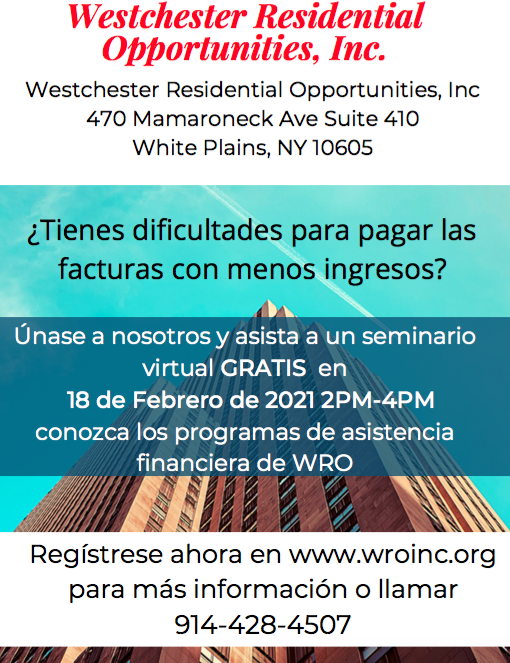
We're starting off the month by looking back at WRO's 2020 testing projects. After adopting practices to the pandemic, WRO conducted nearly 400 tests in 2020. The tests spanned across protected classes (from the source of income to gender identity) and institutions (apartment buildings to college dorms); collectively working to create housing opportunities open to all.
Read more about our 2020 testing projects here.
Make a Difference. Join us!
Help uncover unfair housing patterns and practices by joining WRO as a tester. Email your resume to dsullivan@wroinc.org to apply.
Attend our Fair Housing Month symposium:
Advancing Fairer Housing:
Policy and Other Initiatives
April 21st, 2021: 10:00am to 12:30pm
Panel discussions: The Right to Counsel and Accessory Dwelling Units
&
An attorney training on Introduction to Fair Housing Law (NY CLE available)
Register at wroinc.org or at http://ow.ly/vVOJ50E6mA7
Stay tuned for more Fair Housing Month updates from WRO.
Housing is always essential.
Westchester Residential Opportunities, Inc.
Main Office: 470 Mamaroneck Avenue | Suite 410 | White Plains, NY 10605
Tel: 914-428-4507 | Fax: 914-428-9455 | Email: info@wroinc.org
Westchester Residential Opportunities, Inc. | 470 Mamaroneck Avenue, Suite 410, White Plains, NY 10605
Neighbors Link Virtual Naturalization Clinic- April 6th
Registration is required. This virtual clinic is for Green Card Holders. Please call 914-502-3415 to register.

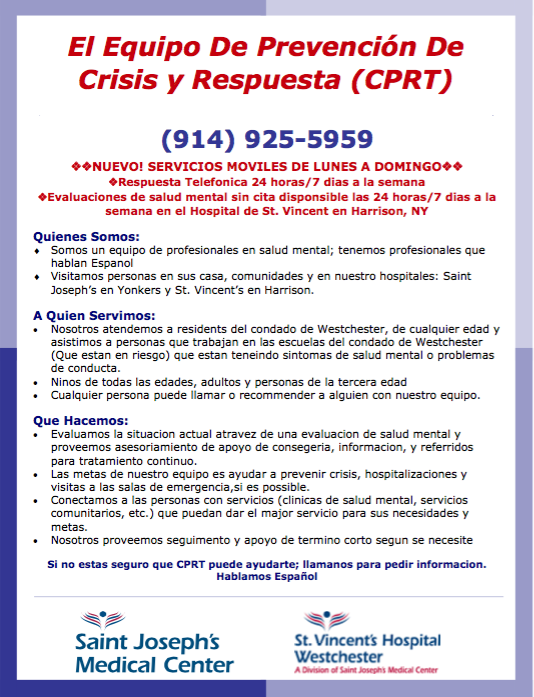
St. Vincent's Crisis Prevention & Response Team Expands Mobile Service
The SJMC-St. Vincent's Crisis Prevention and Response Team has expanded their mobile services to include Sundays. Feel free to distribute these fliers widely.


Statement about Service from Andrew Saul, Commissioner of Social Security
“I want to update you about how things are going at the Social Security Administration.
About a year ago, I took the unprecedented step to close our offices to the public. I did this to keep our employees and you—the public we serve—safe. As we enter year two of the COVID-19 pandemic, vaccines and other precautionary measures give us cause for hope. For now, we will continue our current safety measures as described in our COVID-19 Workplace Safety Plan. This plan is iterative, and we will update it as we receive additional government-wide guidance and information from public health experts in the Centers for Disease Control and Prevention.
Like many businesses and organizations, the pandemic has forced us to adapt. I want to thank our employees for their willingness to embrace innovative ways of working while we continue to deliver our mission. As we examine our work in a new light, we are asking which lessons learned could improve service beyond the COVID-19 pandemic.
We understand that the public wants to engage with us on some matters in person, and our local offices are integral to our communities. We also know that not everyone can conveniently come to us in person and that when you do visit, you want the process to be efficient. For example, we may need evidence from you, but we do not need to interview you in person. We are currently testing drop box and express appointment options for the public to bring in documentation.
Often, you only need to know your Social Security number and do not need a physical Social Security card. However, if you do need to replace your card, we are testing video appointments if you need a new Social Security card but do not need to change any of the information in our records. Although ideas like these began as solutions during COVID-19, we are considering how they could improve service in the future.
Some of these concepts also allow us to consider how we might continue to use telework, something that most organizations and companies have depended on during the COVID-19 pandemic, to drive longer-term operational efficiencies like reducing space. We could use those savings to provide you more online service options and hire more people to serve you more quickly as well as to retain outstanding employees. We will continue to engage our managers, employees, and unions on ways we could use telework to improve customer service and other issues.
We often note that Social Security touches the lives of nearly every American. Be assured that as we continue to evolve, we are committed to serving everyone including our most vulnerable populations who often require in person assistance. We are working with the White House Office of Faith-Based and Neighborhood Partnerships, claimant advocates, and other organizations to ensure our services are accessible to people with low income, limited English proficiency, mental illness, or facing homelessness. We recently added online tools and information pages to our website including:
Online resources for People Helping Others access our services;
Online Outreach Materials for Partner Groups; and
Updated information for Faith-Based and Community Groups including a new toolkit.
As we contemplate the future, we are delivering now. To help improve deteriorating service, we have added over 6,000 frontline employees to help you. We decreased the average wait to talk to our 800 Number agents by one-third and reduced the agent busy rate by over 50 percent in the last two years, and our 800 Number agents handled 1.6 million more calls than they did a year ago.
During the pandemic, we shifted service to the telephone where local office employees answered 13 million more calls last year than they did in fiscal (FY) 2019. They answered your calls in under 3 minutes on average compared to an average wait of nearly 24 minutes in FY 2019.
For individuals who were denied benefits and requested an appeal, we quickly shifted to holding hearings by telephone at the start of the pandemic and then added online video hearings. During the pandemic, we have continued to reduce the number of people waiting for a hearing to 376,000 at the end of February 2021, the lowest level in nearly 20 years. We reduced the average wait for a hearing by over 9 months in the last two years. If you are still waiting for a hearing, please consider scheduling by telephone or video. You can find out more information about telephone hearings here and video hearings here.
The pandemic has significantly disrupted parts of our disability process, particularly at the state Disability Determination Services (DDS) that make disability determinations for us. We have provided the DDSs with additional hiring and overtime to help address a significant increase in pending initial disability cases. The DDSs have been able to reduce the number of people waiting for a decision on initial disability claims by about 100,000 cases since the height of the pending cases in August 2020. In order to make initial disability decisions as quickly as possible, and to reduce the burden on the medical community still stressed from the pandemic, we have focused our limited resources on completing initial requests for disability benefits and have reduced the number of continuing disability reviews we are conducting.
We have made some notable improvements to our online services:
Our redesigned Retirement Benefits Portal helps you prepare and apply for retirement benefits, with clearer, simplified information.
We improved our registration process for our online my Social Security account – more than one million people will register for an account this month.
Our Message Center allows people with a my Social Security account to access notices online instead of by mail.
We implemented an online payment option for people to repay debts to Social Security.
We expanded our online Social Security card replacement service to almost all states. If you need to replace your card, you can request a replacement through your my Social Security account if you:
Are a U.S. citizen age 18 years or older with a U.S. mailing address;
Are not requesting a name change or any other change to your card; and
Have a driver's license or a state-issued identification card from one of 45 participating states or the District of Columbia. If your state does not yet participate in this service, check back soon. More states are added regularly.
The entire team at Social Security is working hard to serve you. We thank you for your patience during the COVID-19 pandemic and we look forward to welcoming you back in our offices when it is safe to do so. We also look forward to continuing to improve all of our service channels to provide you with convenient options to do business with us.”
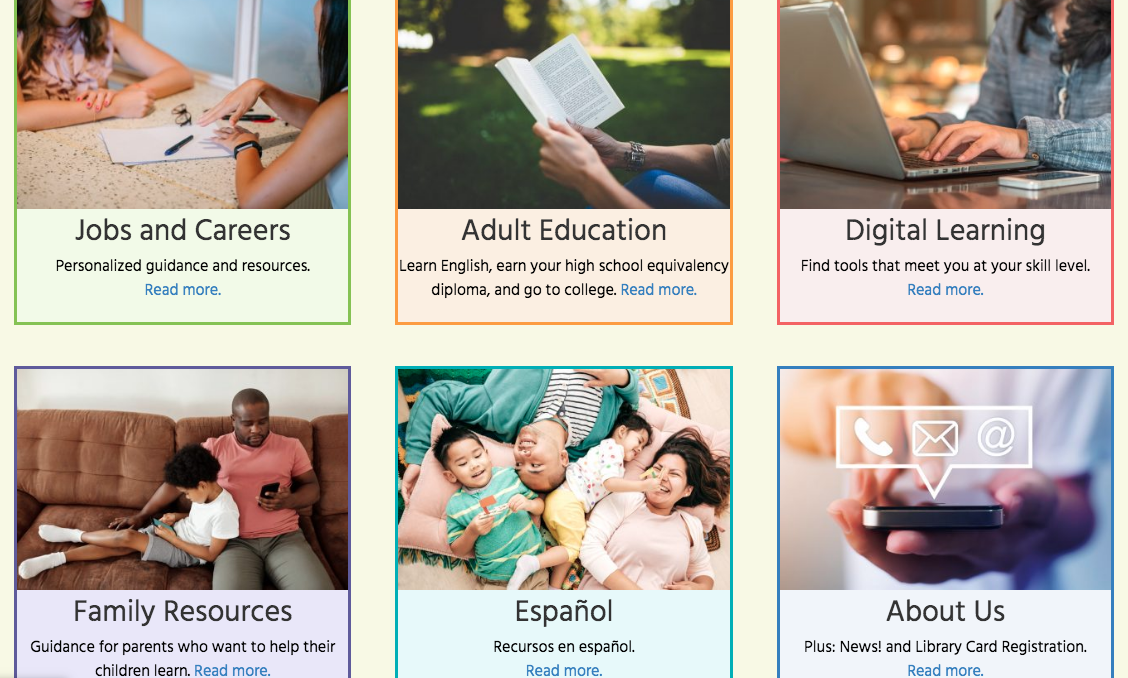
Westchester Library System New Online Learning Resources
The Westchester Library System has launched its online learning resource for anyone in need. FirstFind.org offers resources that can help adults and families move toward their learning goals. Visit FirstFind.org to view all of what they have to offer including food pantries, English courses, and job training.

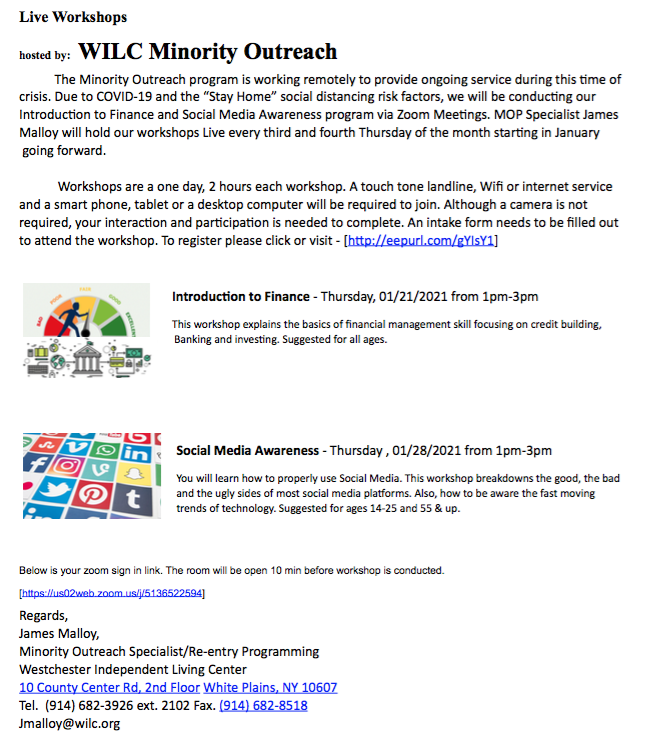
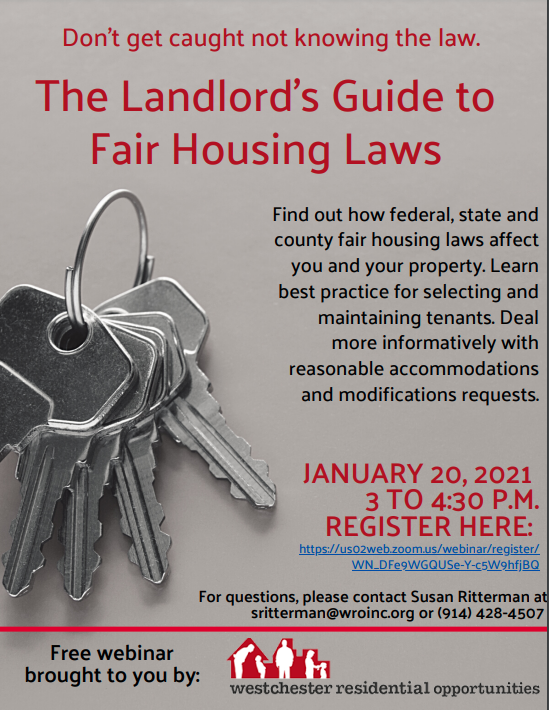
The Landlord's Guide to Fair Housing Laws- Webinar
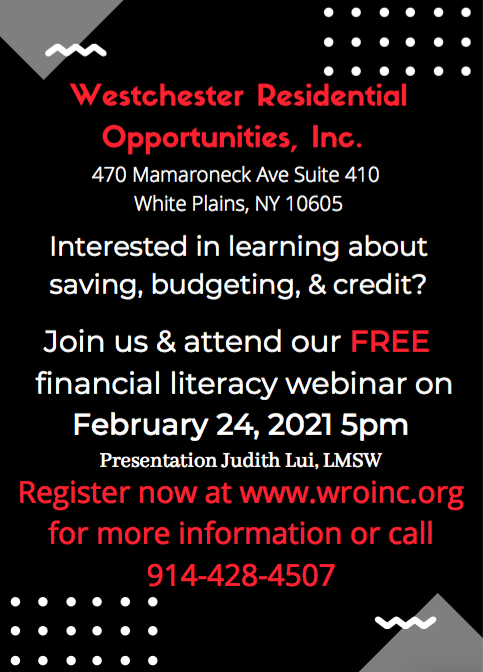
For landlords large and small who are interested in learning more about the fair housing laws, WRO is offering a free webinar on January 20, 2021 at 3 P.M.
Use this link to register, and click here to download the flyer.
Need to Find a COVID-19 Vaccination Site?
To find out if you are eligible to receive the COVID-19 vaccination, use this online portal created by NYS:
https://am-i-eligible.covid19vaccine.health.ny.gov/
A COVID-19 Vaccination Hotline is now open for scheduling vaccination appointments for eligible New Yorkers: 1-833-NYS-4-VAX (1-833-697-4829) .
New guidance from the health department says police departments, public school teachers and mass transit employees will primarily be vaccinated through their groups’ relevant health programs or via their unions.
Homeless Shelter Staff & Residents Now Eligible for Vaccination
Beginning January 11, 2021 Eligible New Yorkers in Phase 1b include:
Individuals living in a homeless shelter where sleeping, bathing or eating accommodations must be shared with individuals and families who are not part of your household
Individual working (paid or unpaid) in a homeless shelter where sleeping, bathing or eating accommodations must be shared by individuals and families who are not part of the same household, in a position where there is potential for interaction with shelter residents
Read More: https://covid19vaccine.health.ny.gov/phased-distribution-vaccine#phase-1a---phase-1b
Update on COVID-19 Vaccination for People Experiencing Homelessness
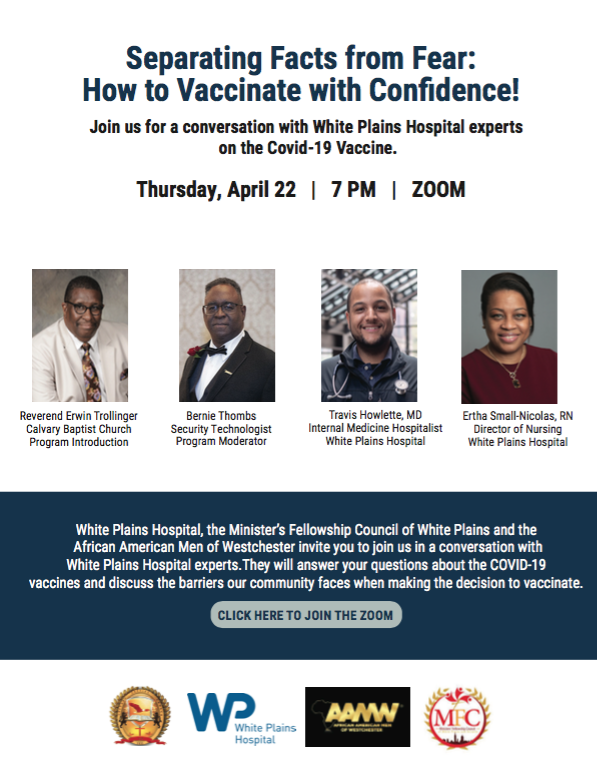
Register for the COVID-19 Vaccination for People Experiencing Homelessness Webinar – January 19, 2021 – 2:00 PM EST
During this webinar, the CDC will provide the most recent updates about COVID-19 vaccination for people experiencing homelessness covering COVID-19 vaccine basics, safety, the prioritization of persons experiencing homelessness for COVID-19 vaccination, special considerations for the vaccination of this population, and an example strategy from the Minnesota of Department of Health.
Only 09 Days Until Tens of Millions of Renters Could Lose Their Homes When The Federal Eviction Moratorium Ends
Learn About Protections and Steps Renters Must Take!
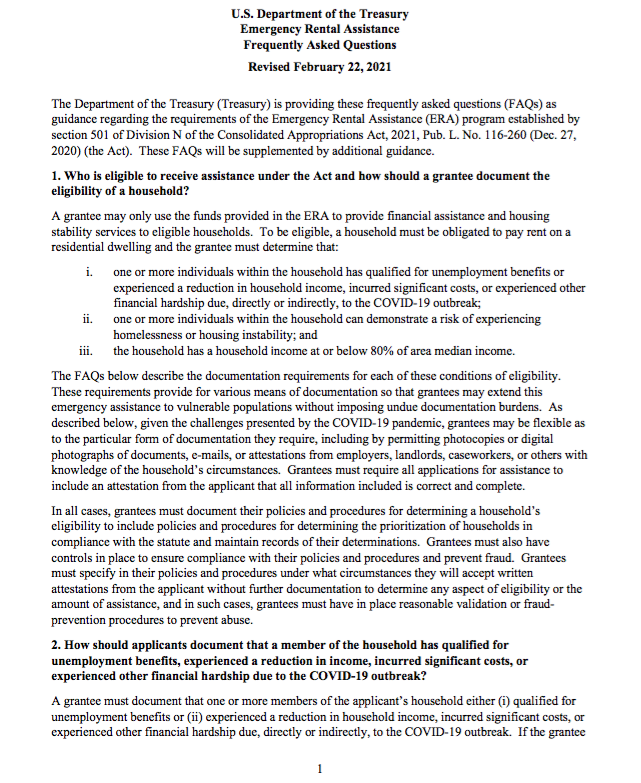
A federal eviction moratorium issued by the Centers for Disease Control (CDC) is in effect from September 4, 2020 to December 31, 2020. The temporary moratorium on evictions extends vital protections to tens of millions of renters at risk of eviction for nonpayment of rent during the global pandemic.
Now we must work to ensure that every renter in need knows about this protection and takes the steps necessary to stay in their home. And we must push Congress and the White House to #GetBacktoWork on a COVID-19 relief bill that pairs a national eviction moratorium with at least $100 billion in emergency rental assistance.
When the moratorium expires on December 31, 2020, back rent will be due, and renters will be unable to pay. In the meantime, small landlords who rely on rental income to maintain and operate their properties will increasingly struggle to pay their bills.
Congress must provide at least $100 billion in emergency rental assistance to keep renters stably housed during and after the pandemic and to ensure we don’t lose any of our country’s essential housing stock.
What’s Next?
To be protected, qualified renters facing eviction should immediately provide a signed declaration to their landlords. For more details about the moratorium and a sample declaration that renters can use, read NLIHC’s and NHLP’s Overview of National Eviction Moratorium and our National Eviction Moratorium: FAQ for Renters [Español].